
AAB methodology

Evidence before standards.

AAB is an evidence-based nonprofit initiative that documents real-world AI education implementations, identifies recurring patterns, and turns reviewed evidence into consensus-driven guidance and standards over time.

2026EMI 1

Exploratory documentation

Records preserve context, source trace, implementation constraints, and early learning signals. Claims remain non-normative.

Primary signalVerified cases and early pilots
Case recordsPilot notesSource traceContext limits

How the evidence registry works

The registry is AAB's public evidence layer. It does not treat every listed record as endorsement or certification. Instead, each record preserves context, source trace, status, and review signals so later reports and standards can show where claims came from.

  1. Collect source-traced records from cases, pilots, frameworks, policies, resources, initiatives, assessments, and community signals.
  2. Classify each record by audience, setting, region, evidence type, source trace, publication status, and AAB relevance.
  3. Review records for transparency, conflict-of-interest risks, implementation context, and limits of interpretation.
  4. Synthesize patterns across collections before producing consensus reports, research briefs, crosswalks, guidelines, or draft standards.

Evidence Maturity Index

From documented practice to standards-ready consensus.

EMI is not a certification score. It is a maturity lens that helps AAB separate early documentation from repeated, reviewed, and standards-ready evidence.

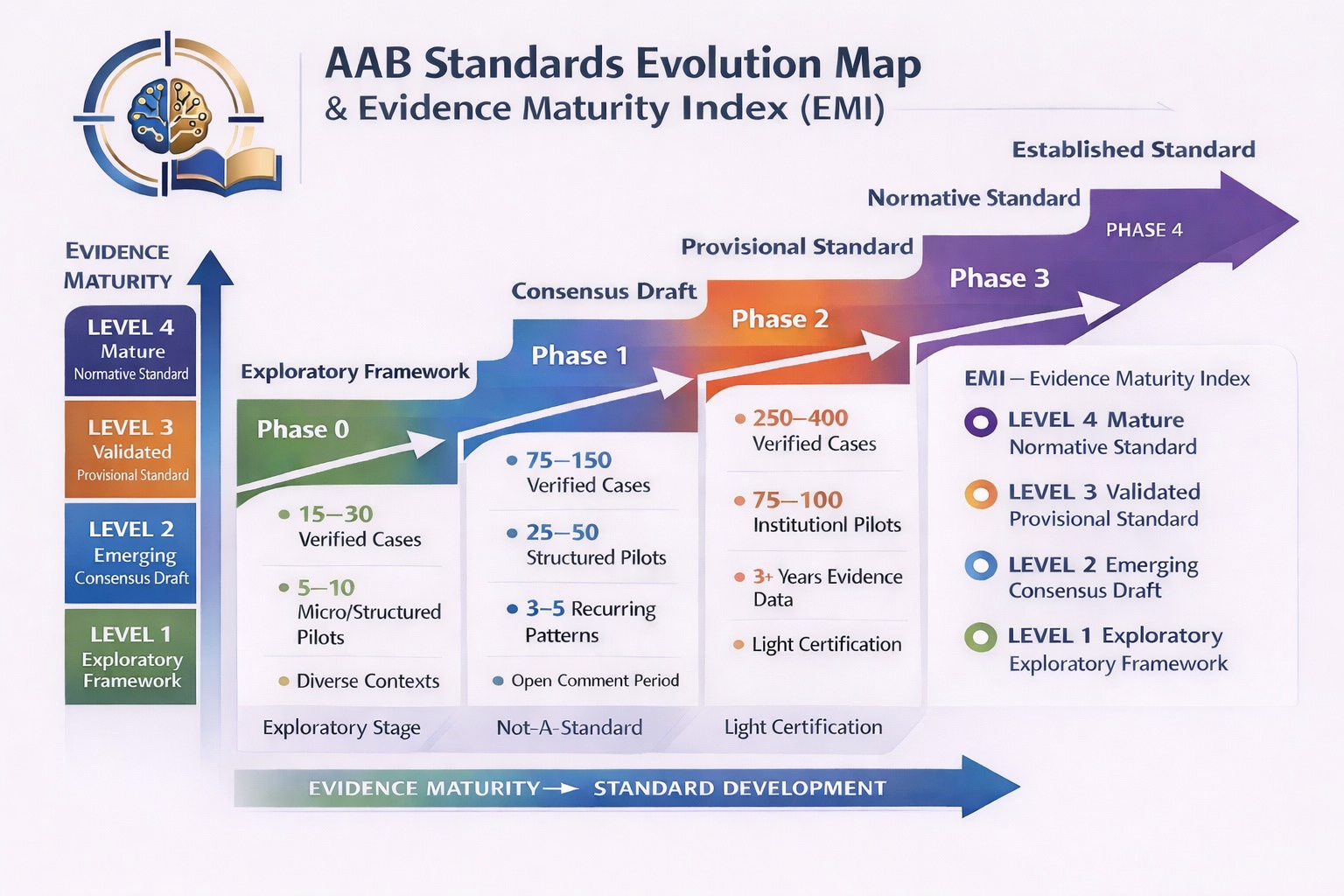
AAB Standards Evolution Map and Evidence Maturity Index
Original AAB EMI roadmap reference, preserved for transparency.

What is EMI?

EMI means Evidence Maturity Index. It is AAB's way to describe how far a body of evidence has moved from exploratory examples toward standards-ready consensus.

  • Level 1: Exploratory framework based on early verified cases and pilots.
  • Level 2: Emerging consensus draft supported by recurring patterns and public comment.
  • Level 3: Validated provisional standard supported by cross-context evidence.
  • Level 4: Mature normative standard supported by broad, longitudinal, and independently referenced evidence.

Cases and pilots

Cases document research studies and real implementations. Pilots document structured implementation efforts with enough process detail to support deeper review. AAB recognizes micro pilots, structured pilots, institutional pilots, and product deployment pilots, but AAB does not operate pilots directly.

Consensus and standards

Consensus reports synthesize what the evidence shows, where it is weak, and what should remain provisional. Standards work comes later, after repeated patterns have been validated across contexts and reviewed by external experts.

Governance safeguards

AAB separates registry inclusion from endorsement, discloses tools used in records, uses conflict-of-interest safeguards for reviewers, and keeps standards approval in human review rather than automated publication.

Roadmap from evidence to standards

The roadmap moves from exploratory evidence in 2026 toward mature standards formation by 2029, with public review and increasing evidence requirements at each stage.

2026Phase 0

Exploratory framework

AAB begins with verified cases, early pilots, and diverse contexts. The output is exploratory and non-normative.

2027Phase 1

Evidence consolidation

A larger registry supports recurring pattern analysis, volunteer review, an evidence report, and public comment draft.

2028Phase 2

Provisional guideline

Cross-context validation and external expert review support a provisional guideline and optional light certification model.

2029Phase 3

Mature standard formation

Longitudinal evidence, diverse demographics, institutional data, and academic references support mature standards work.

Explore the evidence registryView standards work